When we press a key on a modern grand piano and listen to what seems like a fluid, flawless chord, we are actually hearing a “flaw” that has been compromised for centuries.
From Pythagoras of ancient Greece to the physicist Isaac Newton, for over two thousand years, countless brilliant minds have tried to solve an ultimate mathematical loophole in music — yet no one has ever truly “fixed” it. Today, on Retune432, where we explore frequency and cosmic resonance, we will unveil that “gap that can never be closed” at the very foundation of modern music, and trace the turbulent history of Western tuning system evolution.
1. The “Gap” Left by the Creator: 2 and 3 That Never Meet
At the soul of music lie the two most harmonious ratios in nature:
- Perfect Octave: Frequency ratio $2:1$ (e.g., doubling the frequency raises the pitch by one octave).
- Perfect Fifth: Frequency ratio $3:2$ (e.g., from C to G — the most consonant interval after the octave).
If the laws of the universe formed a perfect closed loop, then starting from a fundamental pitch, stacking pure fifths upward (multiplying by $3/2$), then bringing them back down by octaves (dividing by $2$), we should eventually return to the starting point with seamless precision. But the iron law of mathematics mercilessly shatters this fantasy.
🌌 The Century Collision & the Pythagorean Comma
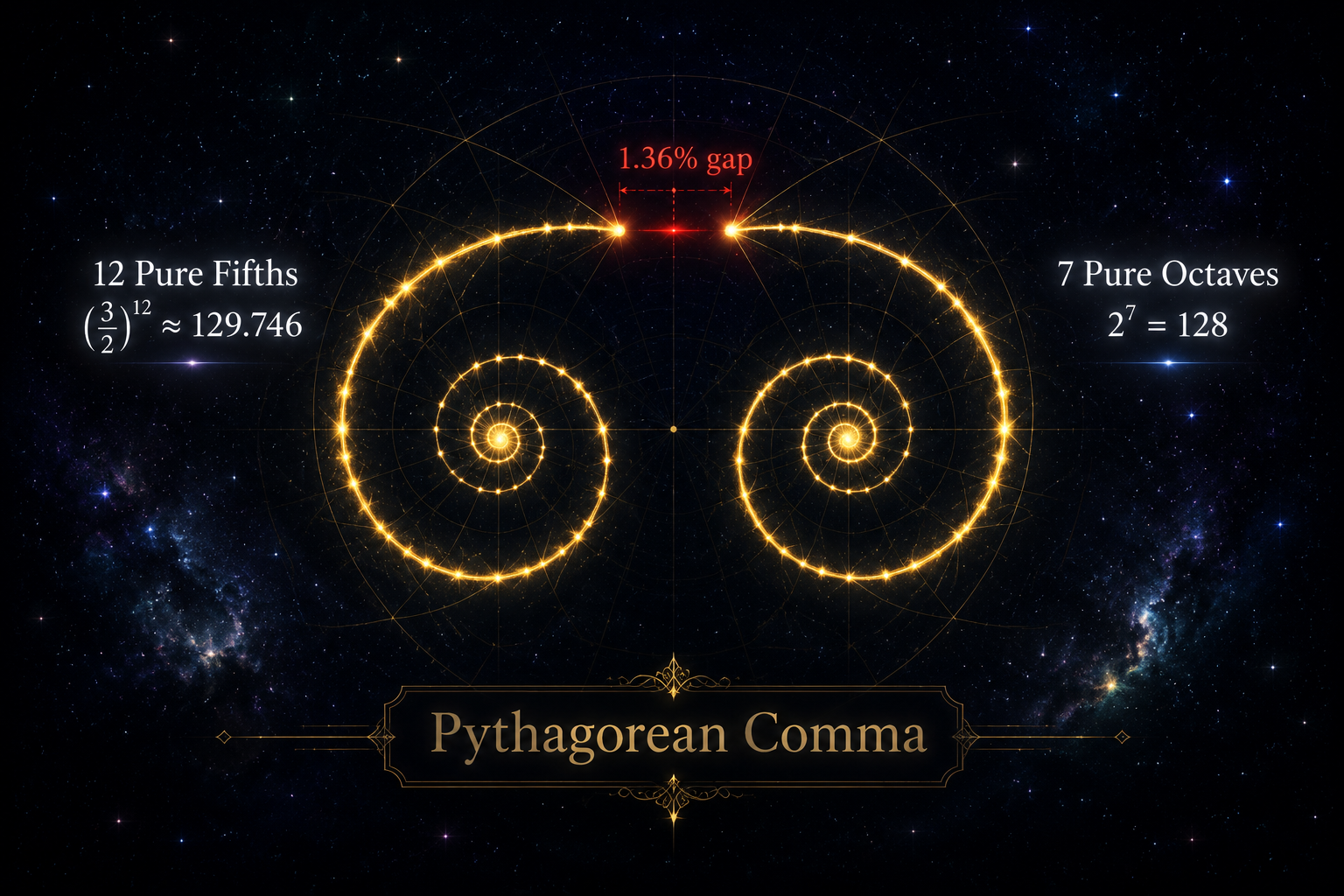
➡️ Left Path: Stacking 12 Pure Fifths $\left(\frac{3}{2}\right)^{12} = \frac{531441}{4096} \approx 129.746$
➡️ Right Path: Stacking 7 Pure Octaves $2^7 = 128$
💥 Collision Result: $129.746 > 128$ We find that stacking 12 pure fifths yields a value approximately $1.36%$ higher than stacking 7 pure octaves.
In acoustic terms, this tiny $1.36%$ discrepancy is called the Pythagorean Comma.
Why does this happen? Because in number theory, any power of the prime 2 can never equal any power of the prime 3 ($2^m \neq 3^n$). This means that no matter how you derive it, the fifth and the octave can never intersect on the infinite number line of the cosmos. This is not a mistake in the Creator’s design — it is the nature of the universe itself. It rejects trivial closure, leaving an “open physical interface” for life and acoustics.
2. The “Troubled History” of Western Music: Searching for the Perfect Lid
Faced with this mathematically unfixable BUG, Western music history over several centuries is essentially a history of compromise — a series of attempts to invent various “lids” to cover up the imperfection.
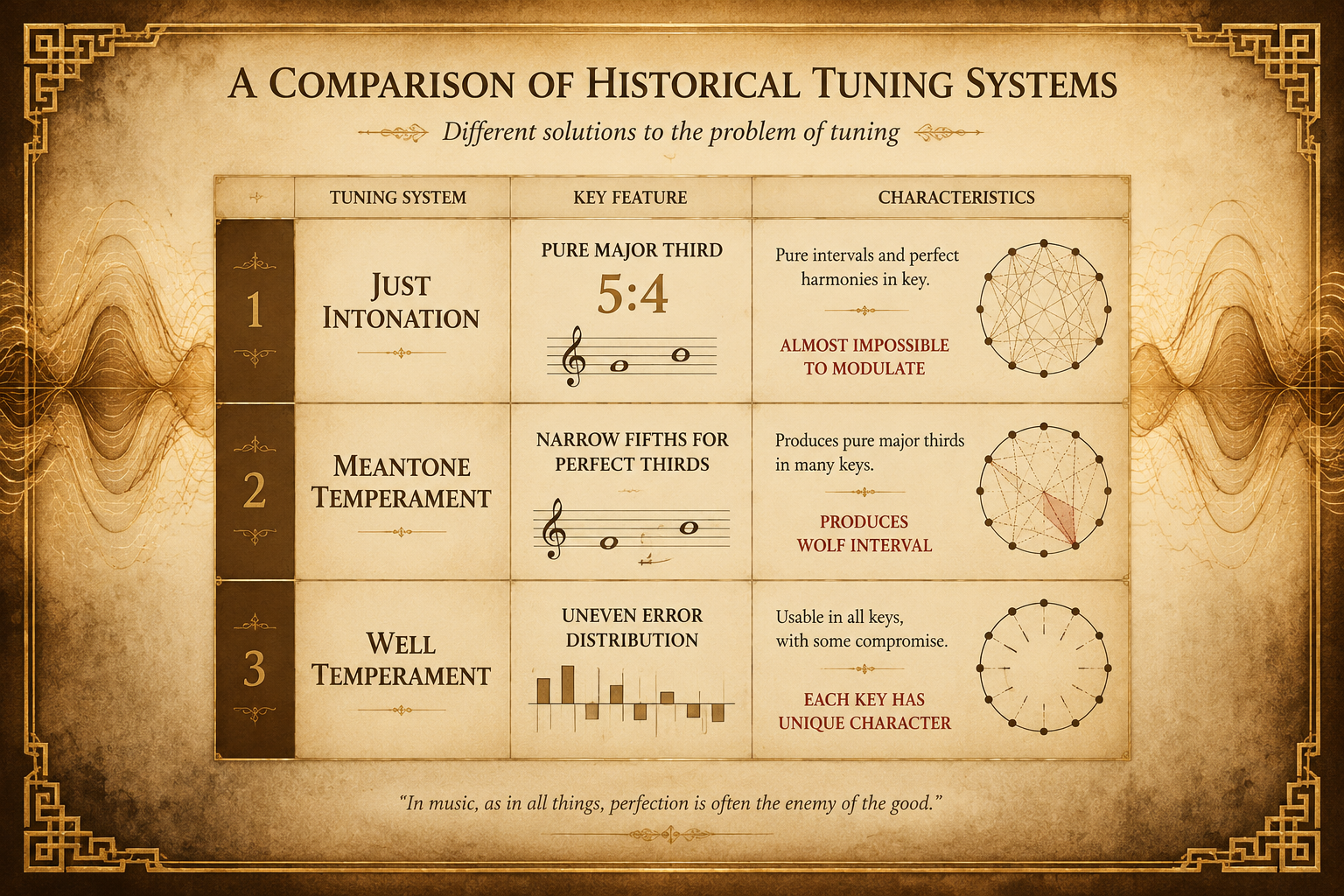
| Tuning System | Core Operating Principle | The Cost Paid |
|---|---|---|
| Just Intonation | Pursues $5:4$ ultra-pure major third | Unequal step sizes; modulation sounds extremely harsh — almost impossible to modulate. |
| Meantone Temperament | Deliberately narrows the fifth to make the third perfect | Produces the unbearably harsh “Wolf Interval”; distant keys become unusable. |
| Well Temperament | Error distributed unevenly, preserving the character of all 24 keys | Extremely complex tuning technique; each key has a distinctly different tonal color and “temperature.” |
Many people have a huge misconception: they think Bach’s monumental work The Well-Tempered Clavier was composed using what we today call “12-tone equal temperament.” This is actually a century-old mistranslation. The German original Wohltemperiert means “well-tempered.”
Under well temperament, the error was not distributed evenly, so each of the 24 keys had its own unique “physical character” and “temperature.” C major was virtually error-free, extremely pure and stable; while C-sharp major contained intense physical friction (beating) and dramatic tension. Bach precisely exploited the “temperature differences” between keys to compose his emotionally diverse masterpieces.
3. The Triumph of the Industrial Age: Equal Temperament’s “Muddling Through”
Given that history has seen so many acoustically pure tuning systems, why did “12-tone equal temperament” come to dominate the world?
The answer is: it is not the mathematical optimum — it is an “industrial-political compromise.”
The method of 12-tone equal temperament is brutally simple: it uses the irrational number $\sqrt[12]{2}$ to forcibly chop up that $1.36%$ cosmic gap and distribute it evenly across 12 semitones.
The cost is devastating — under equal temperament, no third or fifth is perfectly pure except the octave. The damage is most severe for the major third, whose frequency ratio shifts from a perfect $1.25$ to $1.2599$ (an error of $0.79%$). This means that every chord you play on a modern piano is actually producing subtle, rapid “physical beating” — the notes are subtly “fighting” each other.
🎹 The Trade-off of the Modern Keyboard
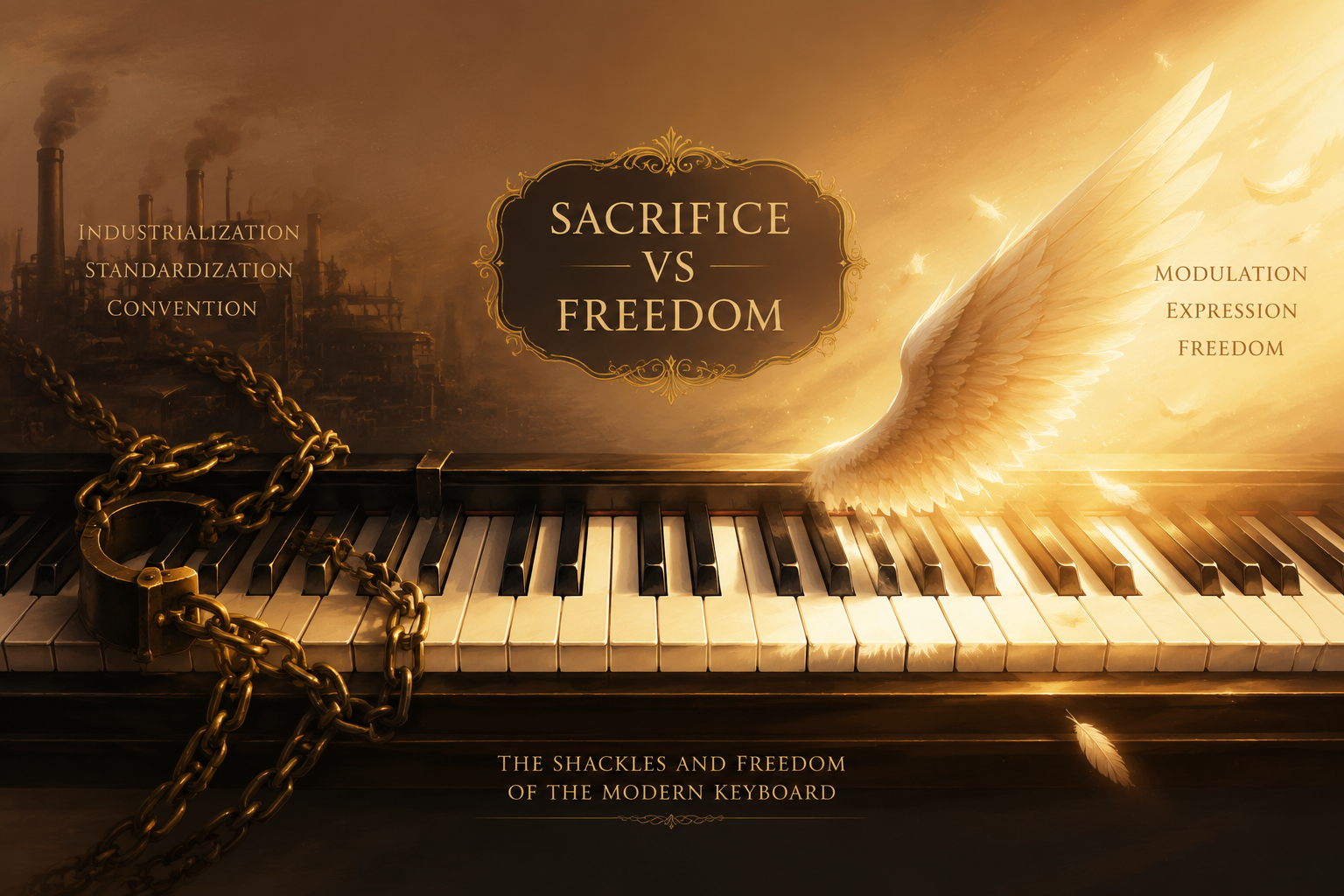
Sacrifice: Local absolute purity and nature’s harmonic resonance. Gain: Universal freedom of modulation and the industrialization of instrument manufacturing.
The reason equal temperament established its dominance in the 19th century is twofold: the Industrial Revolution demanded cast-iron frames for standardized piano production, and Romantic-era composers craved the ability to modulate freely between the most extreme keys. Humanity, in pursuit of absolute structural freedom in the spatial domain, ultimately chose to sacrifice the sacred micro-purity of frequency. From that point on, Western music moved decisively toward the “harmonic school” — a pursuit of vertical richness.
Conclusion: The Perfect Flaw Is the Source of Creation
Now that you know all this, the next time you hear a chord on a piano, you might feel something different. That misaligned $1.36%$, that spiral that can never quite close into a perfect circle — it is not nature’s regret.
Just as the real universe is an infinitely extending spiral, absolute symmetry and closure represent stillness and death. It is this very “flawed gap” that gave birth to the dramatic history from Just Intonation to Equal Temperament, and endowed the Western harmonic system with boundless creativity.
In our next article, we will take you across time and space on Retune432 — to see how the ancient Eastern civilizations, when confronted with the same “mathematical BUG,” chose not to compromise, opting instead for the pursuit of ultimate purity in a single note. We will also reveal how, in the digital age, you can use modern software to break free from the shackles of equal temperament and truly “revive” the pure sound of Bach’s era. Stay tuned!