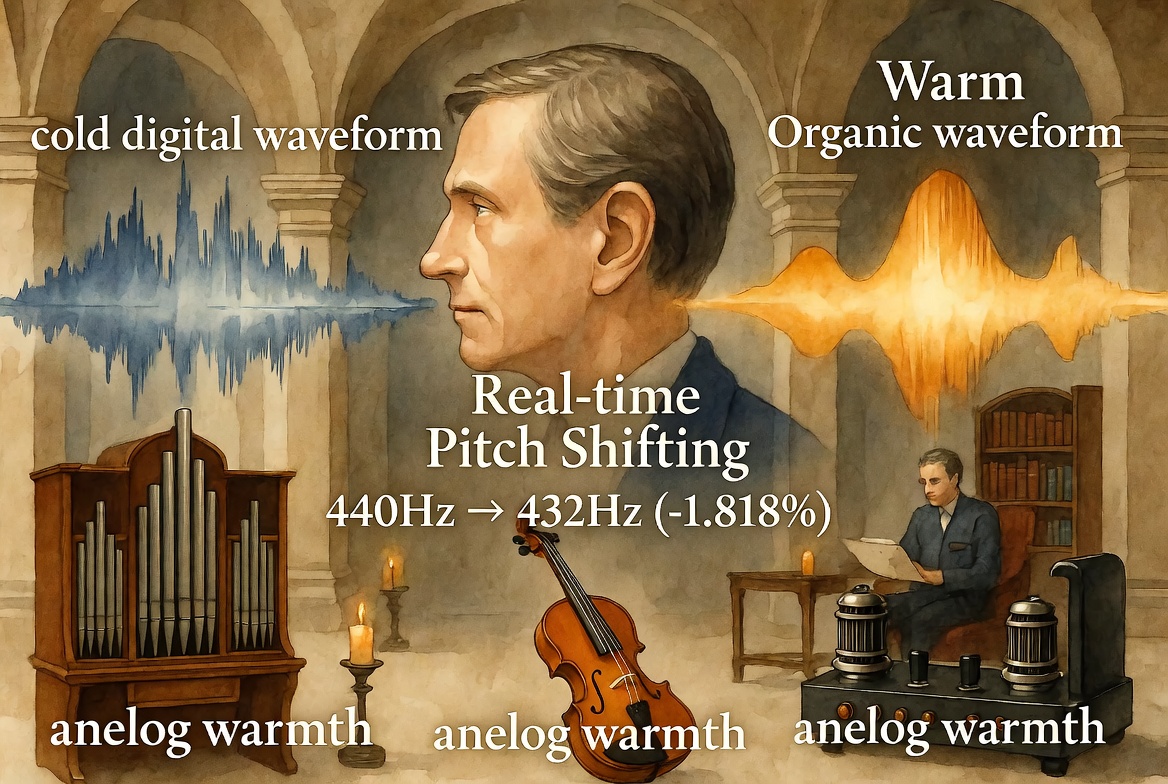
The magic of 432Hz isn’t just about the frequency itself; it is entirely dependent on how you arrive there.
For audio engineers, converting a pre-recorded track in a studio is a standard task. You have unlimited processing power and time to render the file perfectly. But doing this on the fly, directly on a mobile device, while streaming live internet radio? That is the deep water of audio engineering.
Today, we are taking a look under the hood of the ReTune432 DSP engine to explain the invisible technical hurdles of a real-time audio pitch shifter, and how we maintain the warmth of the music without destroying it with digital artifacts.
The Problem: Phase Distortion and “Robotic” Noise
A standard pitch-shifting algorithm faces a fundamental physics problem: if you lower the pitch of a sound, you naturally slow down its speed (think of playing a vinyl record at a slower RPM).
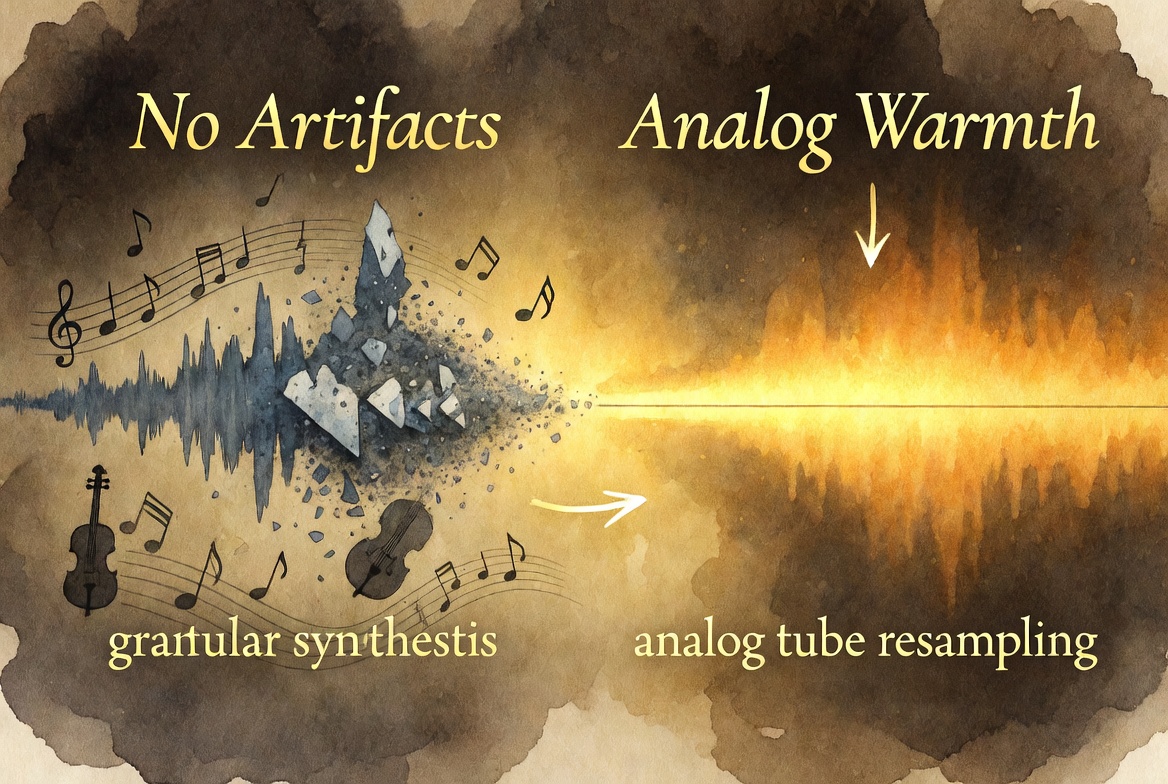
To lower the pitch to 432Hz without slowing down the tempo of the song, ordinary algorithms use a technique called granular synthesis. They chop the audio stream into microscopic “grains,” stretch them, and overlap them.
While this works for simple tasks, it introduces two massive problems for audiophiles:
- Phase Distortion: When the audio grains are stitched back together, their soundwaves often misalign. This causes frequency cancellation, destroying the spatial imaging and soundstage of the music.
- Aliasing Noise (Artifacts): The overlapping process frequently generates high-frequency digital noise—a harsh, metallic, or “robotic” undertone that fatigues the ear.
If you have ever used a cheap pitch-shifting app and felt the music sounded “smudged” or cold, you were hearing these digital artifacts.
The 300+ Live Radio Stations Challenge
The challenge for ReTune432 was uniquely difficult. We aren’t processing perfectly clean, local FLAC files. We are processing live broadcast streams from over 300 internet radio stations globally.
This means our DSP engine has to deal with:
- Unpredictable network latency and packet loss.
- Various lossy codecs (MP3, AAC) and fluctuating bitrates.
- Strict hardware limits (it must run silently on an iOS or Android CPU without draining the user’s battery or causing device overheating).
Building a basic pitch shifter is easy. Building an efficient, low-latency engine that handles live internet radio streams without stuttering or introducing phase distortion is incredibly complex.
Our Approach: Preserving the “Analog” Warmth
We knew that to deliver a near lossless audio experience, we couldn’t rely on off-the-shelf, aggressive time-stretching plugins.
Without giving away our proprietary source code, our solution involves a customized resampling pipeline specifically optimized for the precise mathematical delta between 440Hz and 432Hz (a shift of approximately -1.818%).
Instead of aggressively chopping the live stream into tiny grains, our DSP engine utilizes a dynamic buffering technique. It “reads ahead” just enough to apply a smooth, continuous mathematical transformation to the audio wave. We also implemented custom anti-aliasing filters at the frequency extremes to ensure that the delicate high-frequency details—the “air” around the instruments—are not degraded by digital noise.
As a recent audiophile user described it: the difference between standard 440Hz and our 432Hz processing is like the difference between a cold Solid State amplifier and a warm, analog Tube Amplifier.
By eliminating digital artifacts, we ensure that the relaxation and harmonic resonance of 432Hz shine through naturally, allowing you to listen for hours without ear fatigue.
Experience the cleanest real-time 432Hz conversion. Download ReTune432 Radio today and hear the difference for yourself.